Saturday, 11 July 2009

Parity and more ...

Originally posted at 19:30 hrs Friday. Updated and reposted.


Sooner than we feared, another British soldier was reported killed in Afghanistan, bringing the number to three on the day and the total to 179.

Then, early in the afternoon, we began to get very strong rumours of many more in what was said to be a "major incident". By early evening, five more were said to have been killed, three seriously injured and three more less badly injured.

Early, unconfirmed reports said soldiers had sought cover from direct fire in a compound which was booby-trapped with an IED. Later reports suggested that troops had been ambushed after they had dismounted from their vehicle to investigate an explosion, and were hit by another IED and took casualties. More were killed and injured when the medevac Chinook arrived to pick up the original casualties. The tactics were said to be "sophisticated".

A different report, in The Daily Mail tells a different version, suggesting that after the first hit, "amid the chaos and appalling scenes, the Taleban is said to have opened fire with machine guns and rocket-propelled grenades on the injured soldiers and those going to their aid."

Apache attack helicopters are then said to have been called in to strike at Taleban positions and provide cover as a rescue operation was launched with helicopters ferrying the wounded back to the field hospital at the main British base at Camp Bastion throughout the night.

The men, from the 2nd Bn, The Rifles, were reported to have been in the Sangin area - near Musa Qala. This is not part of the current Operation Panchai Palang (Panther's Claw), which is being carried out north of Lashkar Gah.

The official total for casualties since 2001 now rises to 184, exceeding the number 179, which was the death toll in Iraq. Predictably, The Guardian - commenting on the level when it reached 179 - said that the death was likely to intensify the debate about whether the Afghanistan operation is worthwhile.

The 179th reported killed was a soldier from the 2nd Royal Tank Regiment, said to have died in an explosion during an operation near Nad-e-Ali. He was from the same regiment as Trooper Joshua Hammond, who was killed last week in a Viking.

The AP report at that time was headed, "The Climbing toll raises British doubts on Afghanistan" and cited Conservative MP Adam Holloway, a defence committee member. He said, "The casualties should fix peoples' minds on the fact that we've let the soldiers down ... The death toll means we should do it properly or we shouldn't do it at all."

He added that Britain had never had the troop strength needed to hold ground there and had failed to provide the promised security or reconstruction, leading many Afghans to believe the Taleban militants will outlast Western forces. "We're in a mess," he said.

Guthrie, according to Channel 4 News blames Gordon Brown who, as chancellor when Britain went into Helmand, had given "as little money to defence" as the Treasury could get away with.

And, in The Daily Mail, Doug Beattie, retired recently after 27 years in the Army, said: "Whether it's the 179th or the 200th, the soldier will not think twice about that number. They're just numbers - but every number and every name has a story behind it."

He added: "No soldier serving in Afghanistan will say, 'that's 179', they will say, 'that's my friend, that's my roommate, that's my commanding officer'. Very soon we are going to hit the 200 mark. The likelihood is before we leave Afghanistan we are going to hit the 500 mark - maybe even the 1,000 mark. But they are all false landmarks."

"For the politicians and for the Ministry of Defence," he then said, "public perception of the loss is crucial. For the soldiers on the ground, it won't matter."

However, despite the growing list of British fatalities, troops are continuing to push the enemy back on operation Panthers Claw. This is seen as a "crucial" operation for the security of Helmand.

The fighting had been "exceptionally arduous" with the threat from the Taliban roadside bombs "enormous", Lt-Col Simon Banton tells The Daily Telegraph.

Gordon Brown, who was attending the G8 summit in L'Aquila in Italy, admitted that the troops faced "a very hard summer". He said that there was no question of Britain pulling out until the international community had finished its mission.

COMMENT THREAD

Friday, 10 July 2009

And then there were nine


Two more soldiers have been reported killed in Afghanistan, bringing the total to nine dead in nine days. From the media perspective, this brings the total number killed since commencement of operations in 2001 to 178 – one short of the number killed in Iraq.

In the way of the world, it can be predicted with a great deal of certainty that, once the "magic" number of 179 is reached, this will trigger a huge media-fest, with an orgy of recriminations and comparisons between the two campaigns. Media interest, already elevated, will thereby ratchet up a notch.

There is no point in bemoaning this fact or criticising it – that it what the media does. Throughout both campaigns, it has defined its coverage by the number of dead, hovering vulture-like over the mortality reports, feeding off the misery and despair that accompanies such events.

The sour note, however, is certainly merited as, in my view, if the media had spent a fraction of the effort in addressing some of the deficiencies in the military which had made so many of the deaths preventable, maybe many of the deceased would still be alive. But the media has dropped the pass, preferring instead to run with the tired old mantras of "under-funding" and "over-stretch", for want of addressing the more complex issues.

Yet again though, those mantras have come out to play, this time following Nick Clegg's intervention in the "debate" on Afghanistan.

Their champions this time are the pressure group United Kingdom National Defence Association (UKNDA) which has warmly approved Clegg's contribution to the debate, with the Association's chairman, Winston S Churchill - grandson of the British prime minister – leading the fray.

He notes that Nick Clegg is "the first party leader to draw a direct connection between the scale of losses in Afghanistan and the lack of resources given to our Armed Forces." He adds that, to be successful the campaign in Helmand, "requires a much greater commitment by Britain and, as the Liberal Democrat leader says, a new and more robust approach."

Churchill thus hopes that "other party leaders, on both sides of the House of Commons, will join Nick Clegg in acknowledging the indisputable fact that our Armed Forces are chronically under-funded and over-stretched due to the longstanding squeeze on the defence budget."

The man then goes on to declare that, "They must give a firm pledge not only to exempt the Armed Forces, while at war, from any general budgetary cuts, but also, at the earliest opportunity, increase the resources available to all three Services."

Clegg also gets the support of the Telegraph's Con Coughlin, who applauds "the Lib Dem leader's blatant act of opportunism in breaking with the cross-party consensus on Afghanistan" and asks "Who is going to stand up and fight for our short-changed soldiers?"

One can admire the sentiment, as indeed one can understand UKNDA's anxiety to get some traction but, in the final analysis, neither Clegg nor the Association are doing our "short-changed soldiers" any favours. As long as the debate is stuck in the groove of "under-funded" and "over-stretched", it is going nowhere.

For the reason, one does not have to look very far and, indeed, it can be found in Coughlin's piece. The Lib Dems, he writes, are Britain's most accomplished political opportunists. He thus observes:

In normal circumstances, one might expect criticism of the Government's handling of a major military operation overseas to be dominated by the main political parties. But the failure of both Labour and the Conservatives to address the glaring shortcomings in our Afghan campaign has left the field wide open for Mr Clegg to take centre stage.
One would not expect Labour to criticise their own performance in the campaign, nor openly censure the military for its performance – for fear it might reflect badly on the government – which leaves the Conservatives as the main player.

Here, we have written too many pieces on their failure to want to repeat the experience, but the point stands – that the lacklustre and superficial nature of the debate stems as much as anything from the lack of engagement from the main Opposition party. And, where there is no political engagement, it is very difficult for the media to keep a controversy running until it comes to a conclusion.

To that extent, the media can hardly be blamed for its lacklustre performance, if you accept that its role is reactive, responding to the political agenda rather than setting its own. Many in the media – who spend a great deal of time and energy trying to set the agenda – would disagree with that premise but, in military affairs, it does seem to be the case that the hacks have been content to let the politicians – and some of the military – to set the agenda.

Now they, like opposition politicians, are in a quandary. Slowly, insistently, the case is building which shows that the two faithful mantras by no means define the issues, and they are proving to be something of a millstone for the Conservative opposition.

As it gets closer to taking its turn in the administration, it too is going to have to confront the reality – that there is no extra money, and that throwing what little it has is not going to solve any of the underlying problems. The Conservative Party, therefore, is going to have to invent a new narrative.

One would like to think that the media too can reinvent the narrative, and start examining our military adventure in Afghanistan more closely – and indeed the conduct of our military generally.

There is some sign of that happening, as the more honest journalists see the money flooding into Afghanistan - £3.5 billion this year – for very little effect, despite the optimism of Brigadier Tim Radford, the commander of Task Force Helmand, who said yesterday that the troops on the ground were winning the battle with the Taleban.

For the moment though, with nine down and one to go before the orgy commences, the agenda still seems stuck where it has been for years, with very little progress.

But, when the bell tolls for the 179th – which can only be a matter of days, if not sooner – we could perhaps reflect that we owe it to those who have died, those many more who have been injured, and those who put themselves in harm's way, a little more than a few tired old mantras and a bucket-full of political opportunism.

COMMENT THREAD

Thursday, 9 July 2009

Bombs away ...


The US, for all that the Taleban played a major part in confusing the issue, got it wrong in early May when it launched a series of airstrikes on compounds near the village of Granai in western Farah province.

Despite the recent savagery of the Taleban, killing 25 people, including at least 15 school children, in a bomb attack in the central province of Logar, the Americans have belatedly realised that their killing of Afghani citizens is doing significant damage to the "hearts and minds" effort.

Thus, one of the first moves by newly appointed Army General Stanley McChrystal was to issue "revised guidelines" on the use of air support, telling commanders "to scrutinize and limit" air strikes against residential buildings and other targets that are "likely to produce civilian casualties." Such injuries and deaths, he says, can "turn the Afghan people against us."

According to The Times, this has had a significant effect. Since the guidelines came into force the proportion of contacts that resulted in calls for close air support has dropped from 35 percent of all engagements to 17 percent.

Since the US provides in the order of 90 percent of fixed-wing air support for British operations, this tighter control of air power will inevitably impact on our forces, with fears that this will result in a higher mortality rate amongst our troops.

This has been picked up by the British media, notably The Daily Telegraph which choose to focus on the negative, declaring: "Troop deaths are a risk worth paying, says Nato leader in Afghanistan."

The line here is that McChrystal believes that if civilians began to support the Taliban, it would make the war unwinnable. "In the long run it is more economical in terms of loss of life to operate this way because we can gain the support of the population," he thus says.

Putting that in perspective, he adds: "We want to protect the lives of civilians, but I believe that risks we accept now save coalition soldiers in the long run. If you create antipathy in the population, you are going to create more insurgents."

The Times focuses on that particular aspect, headlining its report with: "Troops in Afghanistan could defeat themselves, says new commander."

It has McChrystal "determined to end the costly bombing errors that he believes have threatened the entire success of the Afghan". It then has him saying: "The Taleban cannot defeat us militarily, but we can defeat ourselves ... We will not win based on the number of Taleban we kill, but instead on our ability to separate insurgents from the centre of gravity — the people. Following this intent requires a cultural shift within our forces."

His own fighting philosophy, we are told, is unwavering. "One thing I would want the British public to know," he says, "is that there are multiple ways to do this and one of them is to use overwhelming firepower."

"We could use artillery and airpower and that would do tremendous damage to the infrastructure and cause a tremendous number of civilian casualties — and in so doing we would probably seal the fact that we would lose the fight over time, because we would convince the Afghan people that no matter what we said, we are not much concerned about their wellbeing."

He adds: "Even if all our good intentions say we are here to save them it goes back to the old cliché of 'we destroyed the village to save it'. If you own the village you feel differently about that. If we operate in a way that creates damage or that actually, God forbid, kills innocents, it is pretty hard to see how the population could do anything but associate our arrival with something that hurts them."

The Times notes that, during the summer of 2007, British and other Western forces operating in Helmand called in an average of 22 tons of bombs per month - almost half the bombs that fell on Afghanistan at that time. Some of that dependency on air power, it says, would appear to have come from the under-resourcing of the British mission.

It is certainly the case that there is a tendency to over-rely on air power, not least by sending out poorly supported or ill-equipped detachments which need air support to enable them to extract if they are confronted by a sizeable number of Taleban.

Elsewhere, we have argued precisely that point, also arguing for the greater use of heavy calibre mortars, a point that is taken up on our forum.

With developing technology, there is also becoming available laser-guided mortar bombs which give ground commanders their own "surgical strike" capabilities over a range of nearly eight miles. With newly available, high performance mini-UAVs commanders can have their own air surveillance, giving them the capability to adjust and direct fire, offering a genuine alternative to air strikes for certain operations.

Even under the current state of art though, it is interesting to note the comments of a serving US soldier who noted that "the Air Force could never hit small groups of personnel." He watched and called corrections on numerous sorties and they could never hit the targets. "My verdict," he concluded, "is if you want it killed use you mortars."

On balance, therefore, it is probably fair to say that, with an adjustment in tactics and the better use of available weaponry, fears of increased casualties through a more restricted used of air power need not materialise.

COMMENT THREAD

An unwinnable war?


The Daily Mail has deployed its heavy weapon on the Afghan front today, rolling out Max Hastings to tell us, "Why Lance-Corporal Elson and our other 175 soldiers killed in an unwinnable war deserve better from this country."

L/Cpl Elson is the last but one, of seven, soldiers to be killed in Afghanistan within a week – killed by an IED. At least Hastings cuts though the cant, remarking that it is hard to find much heroic about being blown up by a mine, the fate of so many soldiers in Helmand.

IEDs, he writes, impact significantly upon morale. Most men cheerfully take their chances in firefights, where superior skills and equipment usually enable them to prevail. But it is a wretched business, to march or ride daily through the Afghan countryside, knowing that at any moment one might be blown to eternity without the smallest chance of averting fate.

Unfortunately, Hastings then repeats the corrosive manta which is so beloved of the MoD and much of the military, telling is that "No armoured vehicle is proof against mines containing up to 500lb of explosive, such as the Taliban now employ." He is actually wrong there, which is why we've put up that famous picture of the destroyed Cougar again. That is reputed to have taken a hit from a 300lb charge – and the crew walked away with very light injuries.

That is not, of course, 500lb, but the weight comparison is misleading, as the really big bombs the Taleban are using are made from agricultural fertiliser – helpfully provided by the Western aid agencies. As such, they have only about a third of the explosive force of TNT and other military explosives – of the type that hit the Cougar. Not always, but even the big bombs are survivable.

As much to the point, although some big bombs are used, they are still the exception – they are difficult to get to site, very difficult to bury and expose the emplacers to a much higher risk of detection. More typical is this example recounted by a "Gateshead soldier" Corporal Dan Henderson.

He was on a routine patrol in Helmand Province when he noticed a suspicious bump in a road frequently used by food and medical supply vehicles. And after inspecting the mound, a 20-kilo roadside bomb was discovered – "the kind which has claimed the lives of scores of our troops."

With no time to spare, Cpl Henderson and his unit sealed off the area, close to the town of Musa Qala, before calling in bomb disposal experts to destroy the device. "It was 20 kilos of homemade explosive – the sort of thing that could do some serious damage," said Henderson. "Even a heavily-armed vehicle could still be knocked a few feet in the air."

He then added: "An unarmed vehicle wouldn't stand a chance. A British convoy was due to move across the route that it happened to be on. The Taliban obviously had their own information."

Even at that level, a Viking would be ripped apart if the bomb was detonated in the right place, but a Mastiff, a Ridgeback – or any other vehicle designed on the same principles – would shrug it off. There may, nevertheless, be bombs that will defeat these protected vehicles, although none have killed anyone in a Mastiff yet.

But to argue that we should not use protected vehicles because "bigger bombs" can defeat them is akin to arguing that soldiers should not wear bullet-proof body armour because it will not defeat RPGs. Similarly, we can dispense with tanks and go to war on bicycles because even the heaviest tank can be knocked out by an anti-tank missile.

To my mind, these are the sort of issues we should be discussing – how to bring protected mobility into theatre so as to restore freedom of movement to the battlefield, not only for mounted operations but also for foot patrols.

Here, we see a link to a BBC TV report from Ian Pannell, describing how the Taleban use multiple IEDs to slow down the advance of British troops, who have to use hand-held nine detectors to clear the way before they can move into positions. This gives time for the Taleban to assemble their forces to mount an attack.


Yet, in their Bush War, the Rhodesians had the Pookie mine detection vehicle (illustrated above) – small enough and light enough to lead the way down tracks, to clear the way for advancing troops. Surely, thirty years on, it is not beyond the capability of our procurement geniuses in the MoD to come up with something similar?

The trouble is – as with the Clegg – we do not get that sort of debate. Clegg, for instance, talks about wanting more troops for the "take and hold" (aka "shake 'n' bake") strategy, without any discussion of the possibility that this might be fundamentally flawed, and can never work.

So it is with Hastings. There is a long whinge in which – in passing – he refers to Major Patrick Little, and cites his comment that, "All is not well in the British Army." But he does not develop the theme. Instead, he withdraws to his comfort zone by declaring that, "There is still supreme professionalism in the British Army, together with a cheerful willingness to accept the risks of a soldier's calling."

There is a growing climate of unrest and anger that they [the troops] are called upon to fight a costly war with inadequate resources, no Afghan gratitude and cynical indifference from the British Government, then declares the Hasting, deciding that "this Labour Government sent the British Army to fight and die in Afghanistan, and bears an absolute responsibility."

For all that, Hasting is "not one of those who favours quitting immediately." Afghanistan's collapse into anarchy could have a grave effect on Pakistan, he says. But, he avers, "the security situation is deteriorating, and those in charge are muddling. We must do Afghanistan differently or admit defeat and come home."

Yea ... alright Mr Hasting. We must do it differently. But how would you do it? Come to think of it Mr Clegg, how would you do it - apart from more European co-operation?

COMMENT THREAD

Wednesday, 8 July 2009

DOTR in the media

The blog and its arguments are getting some attention and interest in the media, the latest being Defence Management, which has published a feature on the design of protected vehicles.

Booker, of course, has been a good friend, with several pieces mentioning the blog, and we recently made guest appearances in The Daily Telegraph, The Guardian, The Sunday Times and even the Sunday Mirror - although the latter lifted a quote from the blog and attributed it to a "Richard Norton". Unfortunately, the Telegraph attributed its quote to Richard D North, who has taken it in good heart.

We continue to have the support of a number of MPs, most notably Ann Winterton, and communicate with others regularly. Some also tell me they follow the comments on the forum, many of which are of exceedingly high quality. I am also told that the blog is read widely in the MoD - not always with approval - and also in a number of other high places.

We are in turn informed by many people of far greater knowledge and influence than ever we will have, making us something of a sounding board for a wide constituency, some - but by no means all - military. We are happy to play that part and would not be ill-disposed to taking the occasional guest post.

The effort required to keep the blog running is huge - especially latterly - and, while other blogs have more spectacular success, in our quiet way, we are quite satisfied that we are having an influence and helping to highlight and steer the debate. We like to think that we are an example of how blogging can work, and that blogging itself works.

We thank our readers - and those sites who link to us - for making it possible. No honest blogger will deny that they live and die by their "hit rate". DOTR daily hits, modest though they might be, are building steadily - that helps give the blog its credibility. Thank you all again.

Back to work ... sigh!

COMMENT THREAD

"Conceptually flawed from the beginning"

Richard Holmes is a by-word for his meticulous military histories and, as a Emeritus Professor of Military and Security Studies at Cranfield University, he is a man to whom one listens.

In a eulogy on his friend Rupert Thorneloe, headed "Rupert should not have died for this", we writes in The Times of a failure to develop a coherent Afghanistan strategy, on which basis, he says, "we should not be risking our soldiers' lives".

In developing his argument, he cites Major Little's recent article, noting his observation that the US Army has undergone a radical transformation as a result of early failures in Iraq, and the British Army has not.

It is tempting, adds Holmes, for some senior officers to lay the Army's misfortunes at the door of our crippled Government, but the problem is more complex. Although the Army had considerable experience of counterinsurgency (and went on at unwise length about the fact), there is little sign that it applied its own doctrine in Iraq.

This piece then provoked agreement from David J Pickup, a former senior lecturer in defence studies at Sandhurst. In a letter to The Times, given the title, "Flawed doctrine to blame for Army failures", his response explains, "Why the shift in Army thinking over the years through lower intensity operations is causing problems today."

During almost 20 years at Sandhurst, Pickup saw a "noticeable shift" in army thinking. After the end of the Cold War, and in common with the other two Services, the Army was looking for a role, he writes. It found it in its "perceived expertise" in counter-insurgency warfare and what became known as peace support operations.

The emphasis in officer training was shifted from traditional war fighting to these lower intensity operations, building on the "successes" in Northern Ireland, Sierra Leone and the former Yugoslavia, which were used as case studies.

These "apparent successes", Pickup goes on, "produced an arrogance in the British Army in which it projected the view that other armies should look to the British as the role models in such activities." This, he notes, "caused much irritation in a number of other countries, particularly the United States, and also in Australia after its experience in East Timor." Then writes Pickup:

Unfortunately, this whole attitude has been called into question by the Army's limited success, if not failure, in Iraq and its difficulties in Afghanistan where expertise in a narrow area of operations has proved inadequate. Consequently we now see senior army officers and their civilian and political supporters using the traditional excuses of lack of resources and poor equipment for their difficulties, reasons that have been cited in almost every failed conflict in history. In reality, the cause has been a doctrine and a philosophy that was conceptually flawed from the beginning.
What leaps out from this passage is the identification of the Army and its camp followers "using the traditional excuses of lack of resources and poor equipment for their difficulties". This is the drum we have been beating for so long that it is hard to remember when we first started. It was Little's theme and now Pickup joins him. They are far from alone, their views shared by many in the corridors of power.

The great tragedy is that the refrain finds a ready hearing in the Conservative Party and its claque and resonates so easily with the public. But it is also a huge trap. Not a few times, we have written that the military machine is insatiable. It could absorb the whole GDP and still come back for more. Tie that in with our more frequent observations on waste and it becomes evident that the more money that is poured in, the more waste there will be.

Crucially though, Pickup accuses the Army of failing through "a doctrine and a philosophy that was conceptually flawed from the beginning." That too, we have been asserting for a considerable period, and is the exact theme of Ministry of Defeat to the extent that we could say, "you read it there first", if that was not too insufferable.

The present drag of operations, in our view, stems from the inability of the Army, as a corporate body, to recognise its fundamental failings and then to address them. But, as long as it believes it has in the Conservative Party a sympathetic ear, it can put off the catharsis until the new administration is in place – whence it will learn the hard way that there will be no more resources forthcoming.

What makes this a tragedy, apart from the deaths of many good men and women for no purpose, is that a delayed reckoning will make the remedies that much harder and more expensive, while the situation in Afghanistan may have deteriorated to the point where it is irrecoverable - as it became, for the British Army, in Iraq.

With that, there is certainly not much sympathy from Pickup. He avers that the other two Services should resist strongly any attempt by the Army to make them shoulder the financial burden of the Army's difficulties. In some future conflict, he says, it may be the Royal Navy and the Royal Air Force that might need those resources.

This should be taken as a warning shot to the Army, and also to the Conservative Party. The "resources" argument is not going to fly. Lack of resources is not the problem and more resources is not the solution. Those who argue otherwise are doing the Army – and the nation – no favours.

COMMENT THREAD

The situation is serious


One truly wonders whether Bob Ainsworth is aware of the cynicism with which his statement is greeted in informed circles when he blithely tells us that conditions are improving in Afghanistan, based on the "message" he got "in Afghanistan when I visited last week".

One recalls the then newly appointed defence secretary Des Bowne visiting Basra on 18 May 2006, when he declared, "Basra is calm and British forces are working hand in hand with their Iraqi and coalition partners. Suggestions that the city is, in someway, out of control are ridiculous." Two weeks later, Iraqi prime minister Nouri al-Maliki announced a state of emergency in Basra, in a bit to contain the escalating violence.

Recalling also Stephen Grey's evidence to the Commons Defence Committee last week, one thus simply speculates how long the "lines-to-take book" was this time. The new defence secretary will have been told what he wanted to hear, and shown that which was convenient to show him, upon which basis he delivers the "upbeat" message that he was always going to deliver anyway – whether he had been to Afghanistan or not.

So taken with Grey's evidence was Jim Greenhalf that he was moved to write his own post on it, observing that much of what was said was worthy of the front page of The Sunday Times.

Anyhow, Ainsworth has delivered his own message to Chatham House today in a keynote speech which was delivered shortly after death of another soldier had been announced, the seventh in a week and the 176th to die since the start of operations in Afghanistan in 2001.

His response to those casualties is charted by The Daily Telegraph which tells us, "More British soldiers will be killed in Afghanistan and there is no end in sight to the campaign, Bob Ainsworth, the Defence Secretary has warned." He adds, "Let us be under no illusion. The situation in Afghanistan is serious - and not yet decided. The way forward is hard and dangerous. More lives will be lost and our resolve will be tested."

So much of the rest of the speech is the usual FCO/MoD extruded verbal material that the only rational thing to do is to glide softly by, although there is some merit in comparing the defence secretary's views with the critique by Matt Waldman, who has some sensible and realistic things to say but, in other ways, is part of the problem.

Of special interest to this blog, however, is Ainsworth's frontal assault on the media criticism of the Viking and other poorly protected vehicles in theatre. "Every effort is being made to increase protection - such as the introduction of Mastiff and Ridgeback troop carriers, the improved armour on Viking and Jackal vehicles, and the more heavily armoured Warthog vehicles coming in 2010," he says, continuing with the "line-to-take" supplied by the military:

With this suite of vehicles military commanders will deploy their assets according to the tactical situation on the ground. But as we develop measures to counter a threat like IEDs, so our enemies adapt - for instance by building higher yield bombs to overcome heavier armour. So let us be clear, sacrificing manoeuvre for heavy armour in every circumstance is not the answer.

We are doing everything we can to counter the IED threat at source. Our forces are finding and diffusing these bombs. But tellingly, they are also concentrating on the networks and the people building them and supplying the technology, the parts and the know-how.

We are getting inside the production process - some in the military call this approach 'getting left of the bang'. When we target the bomb makers and take out the capacity to produce, we cut the threat. Getting left of the bang will save lives - of our troops - and of the Afghans themselves.
This is part of a sustained counter-offensive which has also seen a formal attempt at rebuttal by the Ministry of Defeat, which once again falsely frames the debate as one between protection and mobility, as favoured by the BBC. This is not a ministry that its prepared to learn lessons. Rather it is one that will invest its resources in supporting its existing decisions, however wrong they might be, for want of acknowledging any error whatsoever.

Similarly, Ainsworth is not prepared to admit that which Waldman accuses the government – of miss-spending or wasting aid – not that he could since that involves attacking the FCO and DFID (which we must now learn to call UKAID). Instead, he cites the UK's non-military aid, amounting to £740m since 2001, with a further £500m is planned to 2013. We wonder whether he is aware of the Ferris wheel so generously provided by the British taxpayer, and how that fits in with this general scheme.

What immediately strikes one, however, is the disparity of spending on the military, with over £3 billion in the last three years and £3.5 billion forecast for this current financial year. If the military effort was directed towards civil aid, one might see a wholly different situation in Afghanistan than we see today.

It is rather odd, therefore, that Ainsworth concludes his speech by warning "us" to be under no illusion. "The situation in Afghanistan is serious ... " he repeats. One is tempted to ask: who is this "us", white man? The illusion rests with the secretary of state ... whose policy is not dissimilar to this bridge in the region, which has yet to have the attention of western aid officials. But then, Ferris wheels are so much more useful.

COMMENT THREAD

Tuesday, 7 July 2009

"Not designed for combat"


Currently running in Exeter is the inquest on the death of Pte Jack Sadler, which we covered last year, with the inquest proceedings attracting an interim report from The Daily Telegraph.

Jack, a TA volunteer in Honourable Artillery Company, was a Wimik gunner, attached to the Brigade Reconnaissance Force (BRF) serving 52 Brigade in Afghanistan during Operation Herrick 7.

On 4 December 2007, the BRF, comprising a group of Wimiks, was scouting a route for an artillery convoy of made up of two Pinzgauers each pulling a 105mm light gun, plus DROPS trucks carrying the ammunition. They were on their way to a firing point close to Musa Qala to take part in the operation to recover the town.

Making pitifully slow progress over the rough ground, they had been observed by what they feared might have been Taleban "dickers" as they had skirted a village en route before then reaching a "problematic" steep-sided wadi which they had to cross, following a route they had taken the day before – the only one which the trucks could negotiate.

Because of the heavy trucks the Force was escorting, there were only a very limited number of points at which the wadi could be crossed. While scouting the route across, Jack's Wimik hit a mine, with him sustaining fatal injuries.

No mine clearance had been carried out as the convoy was static while the reconnaissance was carried out. It was a "sitting target" and an attack was feared if it remained in one place too long, so the pressure was on to get the convoy moving again. But, on the rocky ground, the Group commander did not suspect any danger. There were no "Combat Indicators" suggesting trouble and no one in the group "sensed" any danger.

Had there been enough helicopters, the two guns and their supplies of ammunition could easily have been transported by air – as underslung loads. This would be an easy job for a Chinook. But, with a major operation in the offing, there was no spare capacity and, therefore, the battery had to travel by road, with fatal results.

That then puts the focus on the Wimik, deployed in an area where the threat of mines and IEDs was ever-present. And, it emerges from the inquest that a report submitted to the coroner described it as "not designed to be used in a combat situation because of its lack of ballistic and munitions protection".

Needless to say, the Ministry of Defeat is represented at the inquest, with Col Charles Clee holding the line. He was quick to stress that Wimik has since been replaced with newer models fitted with better protection against mines and roadside bombs.

Clee, who is deputy head of urgent operational requirements at the MoD also stated that Wimiks were "valuable to commanders because of their flexibility." Their light weight meant they could operate on local roads. He also trotted out the familiar line that, it was up to commanders on the ground to choose which types of military vehicles to use for different tasks.

Indeed there was a choice ... Wimik, Wimik or Wimik. As for it being able to operate on local roads, as a convoy escort, the BRF was being tied to a predictable route which could only be negotiated by heavy trucks. It, not the convoy, was the "sitting target".

With the Viking in the news, and the past publicity on the Snatch Land Rover, the vulnerability of the Wimik has, by and large, passed under the media radar. Yet more have been killed in Wimiks in Afghanistan than any other vehicle, at least 15 as opposed to ten in the Snatch and Jackal and eight in the Viking.

The hearing continues tomorrow so it remains to be seen what the coroner will make of this, but there is not any great confidence that local coroners can see through the dissemination poured out by the MoD. The precedents are not good.

COMMENT THREAD

A paradise lost?


One of the reasons, we are told, why Lt-Col Thorneloe and his driver Trooper Joshua Hammond could not have travelled in a better-protected Mastiff and instead were killed in a fatally vulnerable Viking was that the bridge network across the Shamalan canal, where the fighting is at its heaviest, was in poor repair and too weak to bear the weight of the heavier vehicle.

The Ministry of Defeat has now released a picture of one of the bridges (above) and simple inspection confirms the poor state. If the other bridges spanning the canal are in anything like a similar condition, then it is not at all surprising that the 23-ton Mastiff could not be used.

One would have thought, therefore, that the bridge network would have been a high priority for redevelopment funding, contributing not only tactical mobility for the Army and the Afghan security forces but also the local population who need a better network to move their equipment and goods.

But that is to reckon without those geniuses in the Department for International Development. Although they have been extremely busy in the Shamalan canal area, they have had slightly different priorities on which to spend British taxpayers' hard-earned cash.

To the utter bemusement of the local Afghanis, DFID has invested no less than £420,000 on a f****** leisure park for Women, complete, you will be pleased to know with a f****** Ferris wheel – (pictured below).

Called Bolan Park, when it was completed just over a year ago, it had "puzzled residents" asking why so much money was being spent on leisure when the most pressing problem – security – was getting worse by the day. Said Amir Mohammad, 44, "If the international community wants our country to be prosperous, they should first worry about peace and security. Then we can have parks."


As to the idea of a park for women, Mohammad Zaher stated the obvious: "The problem is that men are not accustomed to going to parks along with their women. And they won't let women go on their own." Abdul Halek, 22, agreed. "Although our house is very close to this park, we will never let our women go there," he said. "This park will be only for men."

Gul Mohammad, 35, a farmer, had a more pressing reason why women – or anyone else for that matter – would not use the park. He said, "For two years now, there have been remote-controlled explosions on the main Bolan road. I think mines will be laid in this park. That will keep people from going there."

But those brave chaps from DFID nevertheless persevered, trilling away that the nearly 20 acres would provide fresh air, fountains, flowers, picnic areas and recreational facilities for Lashkar Gah's estimated 100,000 people.

As for the IEDs that have been killing "Our Boys" – many of them now home-made using agricultural fertiliser - the aid agencies thought about that as well. Very helpfully this season, they have supplied the Taleban Afghani farmers with a total of 4,749 metric tons, conveniently packaged in 25-kilogram bags.

With such wonderful, intelligent support from our gifted civil servants, we cannot possibly lose the war in Afghanistan. We can look forward to moving from triumph to triumph, allowing the Afghani citizens to revel in their paradises of fresh air, fountains, flowers, picnic areas and recreational facilities provided so generously by British taxpayers.

COMMENT THREAD

First prize

It is all very well pointing out the errors of journalists but the first prize, it seems, must go to the anonymous MoD official who posted this piece on the MoD web site:

Operating in WMIK (Weapons Mounted Installation Kit) Land Rovers, Jackals, Scorpion reconnaissance vehicles, Mastiff armoured vehicles, and on foot, the British troops moved up to capture the important crossings.
When the MoD does not even know the names of the equipment deployed in Afghanistan, there is little hope for us. No wonder they can't buy the right equipment.

COMMENT THREAD

Monday, 6 July 2009

Street of shame

Not a few people in very senior positions, in government and the military, have made disparaging remarks about the low grade of journalists serving as "defence correspondents" in national newspapers. Sometimes, that must be considered as self-serving, but it has to be said that, in many instances, those journalists leave themselves wide open.

In the last week or so, we have seen an unusually high crop of reports on military matters – for obvious reasons – and amongst them, not a few errors. We have already had this gem from the BBC and another from the Mirror but the harvest is not over.

More recently, of the more egregious (or certainly more obvious), we have Sean Rayment – an ex-Army officer – who writes in The Sunday Telegraph about, "The flimsy armoured vehicles which were first sent to Helmand ... ". But his list includes, "armoured personnel carriers dating from the 1960s and rebranded as Bulldogs". These vehicles, of course, were deployed to Iraq, but have never been sent to Helmand. Nor, in the up-armoured form, are they particularly "flimsy".

Then we have Michael Evans in The Times write that " ... a soldier from the 2nd Battalion The Mercian Regiment died when he was hit during a rocket-propelled grenade attack against his Scorpion armoured reconnaissance vehicle."

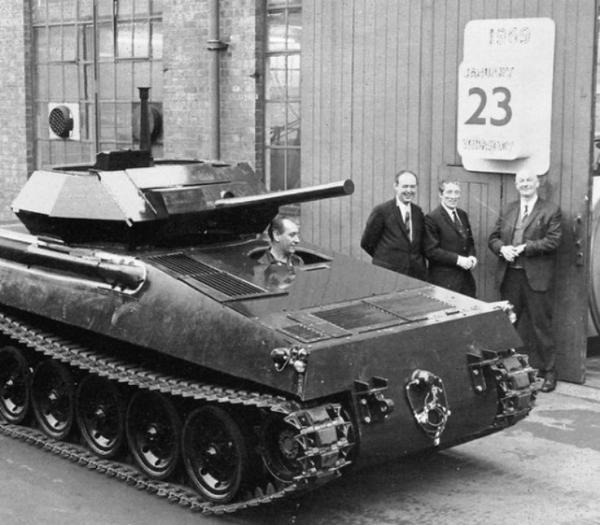
The Scorpion was, of course, withdrawn from British Army service in 1994. It cannot, therefore, have been sent to Helmand, nor attacked by an RPG. The vehicle is believed to have been a Spartan. There is also an issue here, that the Mercians do not operate an "armoured reconnaissance vehicle", the actual vehicle of the series being a Scimitar.

Today, we have Richard Pendlebury and Jamie Wiseman writing in The Daily Mail about "ageing equipment" that "often offers little protection against the bombs", whence they refer to "armoured Land Rovers known as Bulldogs".

They mean either Snatch Land Rovers or Vixens. There is a picture of a Bulldog at the top of this piece.

In the context of the vehicles being branded "ageing", they refer to the "Viking tracked vehicle". These were not issued to units until 2001 – which is positively youthful in military terms - and many of the vehicles delivered to Helmand were brand new. But the pair also tell us that IEDs planted in the path of military vehicles "usually include armour penetrating rods or cones designed to cause maximum destruction". They don't. In particular, the EFP which projects a copper "cone" is largely confined to Iraq. Very few have been detected in Afghanistan.

Now, we all make mistakes ... my previous piece has one, where I have identified the wrong vehicle which GD intends to submit to the MoD for the CVR(T) replacement competition. But there are mistakes and mistakes. When journalists make such obvious – to anyone with even limited knowledge of the military – and basic mistakes, it suggests that their knowledge base is extremely limited.

That does not, of course, mean that nothing they write can be trusted. Much of what they write will be correct. But it does imply that they are ill-equipped to understand the finer – and often more important – points about military equipment that will enable them to report competently on what they see and are told.

It is Private Eye which runs a regular series commenting on the errors and behaviour of the Fourth Estate – under the heading Street of Shame. We are considering our own version. It looks as if we will not be short of material.

COMMENT THREAD

FRES lives ... sort of


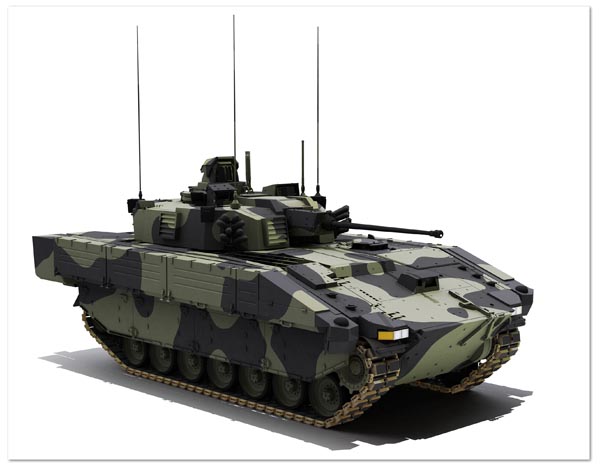
We are informed that the MOD is to invite two British companies to tender to supply reconnaissance and reconnaissance support variants to replace the aged Scimitar and Spartan vehicles now on operations in Afghanistan.

The two companies are BAE Systems Global Combat Systems and General Dynamics (UK), who will be bidding for a project grandly named the Future Rapid Effect System Specialist Vehicle (FRES SV). In reality though, with the FRES utility vehicle dumped for the foreseeable future, this is simply a much overdue replacement for the CVR(T) series which should have been scrapped many years ago.

General Dynamics will, no doubt, be offering a version of the Piranha, configured on similar lines to the Canadian LAV-25 Coyote - arguing for commonality with the proposed Utility Vehicle, if it is ever purchased.

BAE Systems may be submitting a version of the Swedish-built CV-903 Mk III, recently purchased by the Danish Army (pictured), on the basis that a tracked vehicle would be more suitable for the role.

Whichever platform is chosen, the likelihood is that it will be fitted with the French-designed Nexter CTA-40 caseless ammunition gun, together with the BAE System turret which is being used for the Warrior Lethality Improvement Programme (WLIP).

Although the prospect of a replacement for the CVR(T) series is good news – which should always have been put ahead of the utility vehicle – by the time the MoD nannies have finished with their procedures and integration programme, it could be some years before we see any new kit in theatre. By then, of course, it will be the Tories who will have to pay the bill.

COMMENT THREAD

Sunday, 5 July 2009

Tactical mobility


Afghan civilians using mobile phones acted as lookouts for the Taleban before they attacked Lt-Col Thorneloe's Viking convoy, reports the Mail on Sunday. The civilians, who left the area before the attack, had formed a "screen" to observe the convoy, enabling the Taleban to "activate the improvised explosive device".

A military source is cited saying that the early signs are this was a classic "dicking" operation that allowed the Taliban time to set their roadside bombs.

That military convoys in Afghanistan are under constant observation, however, is not at all news. The photograph shown was published by the BBC last year to illustrate the nature of the problem, suggesting that the boy with the bike could be a dicker.

We discussed the role of dickers only last week and, in the context of the Thorneloe incident, further undermines the case for the Viking.

Its off-road performance is widely cited as enhancing "tactical mobility", making the movements of the vehicle unpredictable and thereby frustrating the attempts of the bombers. But, were there is constant observation, that dynamic changes and the unpredictability factor is of less value, especially when the vehicle is being used for supply runs and similar "routine" tasks.

The term "dicker" seems to have been coined in Northern Ireland during the Troubles where, perversely, the very presence of "dicker screens" was often used to warn of impending action or terrorist activities (see this report - 156 pages pdf). Similarly, the sudden departure of civilians from an area and, particularly, the absence of children, are all "indicators" that trouble might be imminent.

The broader point from this, though, is that the measure of "tactical mobility", as applied to a conventional military campaign, needs to be redefined in counter-insurgency operations. All too often, as was the case in Iraq, freedom of movement was limited not by physical restraints but by politically imposed measures directed at casualty avoidance – often in response to media publicity or in anticipation of such publicity.

Under these circumstances, vehicles with good terrain crossing performance or other attributes (such as size or weight) can end up being less mobile than vehicles with inferior performance but with higher protection levels.

Judgement of the "mobility" criteria for a military vehicle in a counter-insurgency campaign, therefore, has a political as well as military element. Neglect of the former can impinge on the latter.

That was the essential mistake made by the military planners in deploying the Viking. In judging its suitability on military criteria alone, they neglected the political dimension. Had, of course, this been taken into account, the vehicle should never have been deployed, exposing a capability gap that would have had to have been filled.


Here, the "experts" recoil in horror at the thought of a "quick fix" which might be good enough for most roles but not providing the perfect answer – such as to take a standard MRAP - a 4x4 Cougar would do nicely (illustrated above) - and fit it with tracks from an already existing vehicle, such as redundant M-113s, for example.


Once again, though, one must draw upon German World War II experience where, after the mobility problems experienced on the Eastern Front in 1941, the Army had a fully-tracked supply truck up and running for the 1942 season. Developed by Steyr, it was called the Raupenschlepper Ost (illustrated above) and used the transmission of the standard 1½ - tonne truck. Although far from perfect, it gave valuable service until 1945, with over 28000 vehicles produced.


Incidentally, another aspect of the mobility equation, the bridging tank, was available and used successfully by the German Army in 1940 (illustrated above). Such bridging equipment is currently on the British Army inventory and, with the web of canals and watercourses in Helmand, there should be plenty of use for it, providing additional flexibility that even the Viking cannot match.

In this realm, there are no insoluble problems – only lack of will and application. But a nation that is not flexible and cannot improvise is one that is past its sell-by date and does not deserve to win.

COMMENT THREAD

They should not have died

I am sorry if it offends – and it certainly does upset some of the military types, and the "consultants" and designers responsible for the Viking and the decision to deploy it to Afghanistan – but, on the basis of all the evidence we have, Booker and I both have come to the conclusion that Lieutenant-Colonel Rupert Thorneloe and Trooper Joshua Hammond should not have died.

That they did die is the greater offence and, while it must always be remembered that the proximate cause was a Taleban bomb, in a cold-blooded act of murder, the neglect of the MoD and all those involved with the deployment of this vehicle is a contributory factor. Thus does Booker in his column today point the finger squarely at the MoD.

From Mick Smith (and others) in The Sunday Times, we get the first published confirmation of that which we had already worked out, that Lt-Col Thorneloe was riding in the front passenger seat of the Viking. With his driver, they were in two of the most vulnerable positions in a dangerously vulnerable vehicle.

In other circumstances, writes Smith, Thorneloe would have travelled by helicopter; but it appears none was available. He notes, however, that the MoD declined to confirm or deny this.

Without this facility, and wanting to "get up among his boys at the first possible opportunity," Thorneloe found that, "A resupply convoy was going up there and he hitched a lift on that." As the Viking approached a canal crossing, it passed over a hidden IED which destroyed the front cab. Thorneloe and the driver, Hammond, died instantly.

The lack of helicopter notwithstanding, if Thorneloe had not been in the vehicle, someone else would have died. And the incident would already have been a footnote in the history of the campaign, blanked out by the operations being mounted, not least the big push by the US Marines further south.

As for the Viking, this was originally produced as an amphibious assault vehicle and delivered to the Royal Marines in 2001, for use in the Arctic Circle as a mobility platform when reinforcing the Nato northern flank, assisting the Norwegians against a Soviet invasion. It was a Cold War machine, designed for a different purpose.

In that role, the question of protection had been considered – and the machine was armoured against ballistic threats. However, within the "Littoral Manoeuvre" parameters set at the time, a decision was made deliberately to skimp on mine protection to save weight. This was to enable the machine to be lifted by a Chinook helicopter and to maintain the amphibious free board clearances.

Before deploying the machine to Afghanistan, the protection levels were reviewed but, despite the known mine threat, the "assumptions about the overall mobility benefits" were considered valid – the ability to swim and be lifted by a Chinook. With no Chinooks actually available to lift these machines, therefore, the Viking went in October 2006 to war dangerously unprotected, simply to maintain its ability to swim through the waters of landlocked Afghanistan.

The original protection level was specified as proof against an explosion of no greater than 500gm under the belly, with a higher resistance to a blast under the track. This was claimed to meet the technical standard known as STANAG 4569, to level 2a – resistant to a 6kg explosion and thus protection against a common Russian anti-tank mine, the TM-46, with a charge weight of 5kg.

However, also present in some numbers in Afghanistan is the Russian TM-62M, with a charge weight of 7kg and fuzes which enable these mines to be detonated against the belly of a vehicle, or by vibration rather than contact, as the vehicle passes over the mine without the wheels or tracks riding over it.


For that reason, the US mine and blast resistance standard – for an underbelly explosion - is set at 7kg, and it is this standard that the British mine protected Mastiff (pictured above) also meets and in fact exceeds a level equivalent to STANAG level 3b.

At that level of protection, no soldier has ever been killed in a Mastiff in either Iraq or Afghanistan, despite being hit by explosives considerably exceeding its stated protection level. Much of that is due not to the blast resistance, as such, but to the v-shaped hull design of the Mastiff, which the Viking also does not have. It is entirely reasonable to assert, therefore, that had Thorneloe and Hammond been riding in a vehicle similarly protected and designed, they would have survived the blast.

However, the reasons for the MoD's neglect in not providing suitable vehicles are complex. Originally, the Viking was Royal Marine equipment, sent to Afghanistan because that was their standard mobility platform, with which they had trained.

So short of high mobility platforms was the Army though, that when the Marines departed after their six-month tour, a decision was made to keep the Vikings in theatre. Had they been withdrawn then, the MoD might just have got away with it, because the Taleban had not yet worked out quite how vulnerable these formidable-looking machines were, and how easily they could be destroyed.

The shortage of vehicles was nothing to do with money – as Booker reminds us in his column. At £700,000 each, Vikings are far from cheap, and neither is their maintenance. What had happened since 2003 was that, in effect, the Army had frozen development or purchase of any new armoured vehicles, while it worked up plans for a £16 billion fleet of high-tech wheeled armoured personnel carriers and other armour to meet Blair's commitment to the European Rapid Reaction Force (ERRF).

Although faced with a vicious insurgency in Iraq and then Afghanistan, the politicians and the Army were not prepared to spend on new specialist vehicles for these theatres, protecting instead the funding stream for the ERRF equipment.

Without that – had they given the time and attention to the needs of these real wars, instead of the imaginary wars of the future alongside our European "partners" - it would have been perfectly possible, even with limited funding, to have developed a high mobility platform for the Army, with the same protection levels of the Mastiff. That would have allowed the Marines to keep their Vikings for the role for which they were originally designed – amphibious assault.

That this has been the case has been hotly denied by the MoD, which is already facing legal cases over its deployment of the Snatch Land Rover. But the real story is told in Ministry of Defeat, an account "winning warm praise from various serving and former Army officers who recognise only too well what a disgraceful part the MoD has played in two awful military fiascos," writes Booker.

Already, we have been booted out of Iraq by prime minister Nouri al-Maliki, after we had so signally failed to carry out the task contracted to us there, and as our troops have been slaughtered in poorly protected vehicles in Afghanistan, on the altar of "European co-operation", it must surely be only a matter of time before we hand over completely to the better-equipped Americans – whose Marines have left their amphibious assault vehicles at home – declare another great "victory" and depart.

In the meantime, in the baking heat and dust of Afghanistan, more soldiers must die. Many more will be seriously injured.

COMMENT THREAD

Saturday, 4 July 2009

The wrong debate

See also: Time to get this sorted

With its unerring instinct for getting it wrong, the BBC – in the persona of its defence correspondent Caroline Wyatt – is framing the debate over the use of the Viking and the deaths of Lt-Col Thorneloe and Tpr Joshua Hammond as one of "armour versus mobility", suggesting that there is "a fine balance."

To be fair, she is not the only one to get it wrong. This is the way much of the British military thinks, thus channelling the argument into a sterile comparison between the merits of the heavy but well-protected Mastiff and the lighter, more mobile vehicles such as the Viking and the Jackal.

As the military would have it - enunciated by Amyas Godfrey to the BBC and also to The Guardian - the choice of which armoured vehicle to use in any campaign is a question of balancing risks and benefits.

"It is all about getting the balance right between the need for armour and the need to be light and flexible, with the ability to go off-road," says Godfrey. "Mobility is a form of protection in itself, and with heavier armour, you sacrifice mobility for greater protection."

At that entirely superficial level, there is some merit in Godfrey's assertions. Roads are a natural target for terrorists and, as that picture above shows, one particular weak point is the culvert bomb, which is fiendishly dangerous and requires a great deal of manpower and other resource to thwart. The ability to transit an area avoiding the roads – and such devices – is therefore an obvious advantage.

However, one almost gets tired of the repetition here, having yet again to draw the distinction between design and weight. Godfrey, in common with so many of his ilk, equates protection with "heavier armour".

Such are the constraints on their own thinking that they seem incapable of understanding that mine/IED protection is not primarily a function of weight of armour but of design – the principles of which we elaborated recently. It is this complete failure of the military establishment to understand these fundamentals which lies at the heart of this sterile debate.

To that extent, as we have so often observed, mobility and protection are not mutually exclusive. It is only the sterile thinking of the British military which makes it so. It would be perfectly feasible – by design - to produce a tracked vehicle with the mobility of the Viking, yet with the inherent protection of a Mastiff. This should not add significantly to the weight or, more particularly, hamper mobility.

Those proponents of the Viking, who argue that its mobility has saved more lives than its lack of protection have lost, are therefore arguing from a false premise. Mobility and protection are not mutually exclusive – it is possible to have both.

There are, however, other issues to address, where the whole argument on off-road mobility falls apart. One of those is the "pinch" or "choke" point problem, which we have also discussed. No matter how good a vehicle's off-road performance might be, there are natural features in any terrain which restrict and funnel movement into predictable areas, and it is there that ambushes are so often mounted.

Even in wide open spaces, there are constraints. As Tom Coughlin writes in The Times of the Viking, "in the heavily irrigated fields along the Helmand river, room for manoeuvre is more limited, and churning up farmers' fields with its tracks will not help to win the support of the local populace."

This then leads to a paradox, where designers optimise for off-road performance and then, to deal with the occasional but deadly ambush, add armour to their vehicles. They end up – as they did with the Vector – compromising performance without significantly improving protection. The outcome is an off-road vehicle with less performance than a custom-design protected vehicle, from which stems the mantra that you cannot keep increasing weight.

Locked into this trap – yet under pressure to reduce casualties - they have nowhere to go but to develop bigger and stronger vehicles in order to carry more armour. This is precisely the line adopted with the Viking, where it is to be replaced by the Warthog – a vehicle with heavier armour but sharing the same design flaws.

However, Major-General Julian Thompson, who commanded 3 Commando Brigade Royal Marines in the Falklands conflict in 1982, makes a different point. He tells The Times - undoubtedly based on his experience in Aden and then Northern Ireland: "The question is not whether one vehicle or another is sufficiently armoured, it's about the lack of helicopters. We need more helicopters in Afghanistan to ferry troops in high-risk areas."


This is a good point. The ultimate mine protected vehicle is the helicopter. Unfortunately, as we pointed out earlier, the option of relying on helicopters is not available to the coalition forces, and not entirely because there is a shortage.

Unlike Northern Ireland, where the security forces were the main target of the terrorists, in Afghanistan the population in general is being attacked, particularly on the roads, which are needed to move large quantities of supplies. They are used heavily by Afghan security forces and civilians.

To abandon those roads to an enemy which is indiscriminately slaughtering civilians as well as the security forces is also to abandon any attempt at winning "hearts and minds". The military must maintain a strong presence on the roads and, therefore, will always be exposed to a risk that cannot be mitigated by the greater use of helicopters.

Nevertheless, there are limitations to the amount of protection that can be afforded, even in the best designed vehicle. To make that point - or something akin to it - Caroline Wyatt calls in aid the spokesman for Task Force Helmand, Lt-Col Nick Richardson.

He insists the Viking remains an excellent vehicle, telling us that, "Armour is the last resort in terms of defeating the threat. It is much better to be able to avoid the threat than to have to rely on the armour defeating the threat when it is initiated. He then states: "It doesn't matter how much armour you have - it can always be overcome if you make the charge big enough."

The "bigger bomb" threat is overstated, an issue we have promised to address in a separate post, and neither should "armour" (more properly, protection) be considered the last resort.

In their Bush War between 1962 and 1980, the Rhodesian Army found that it was impossible to ensure that the thousands of miles of unpaved roads were kept clear of mines and IEDs. Therefore, vehicle protection was treated as a routine precaution. (See this study by Franz J Gayl - 147 pages, pdf).


That notwithstanding, protection is by no means the only precaution. Route clearance – using basic devices such as mine rollers (pictured above) plus more sophisticated technical aids, and even sniffer dogs - route proving, surveillance, routine patrolling to deter activity, intelligence, interdiction of supplies and disrupting the bomb-makers are all part of the armoury which must be deployed to defeat the joint threat of the mine and the IED.

To distil the argument down to one of "armour versus mobility", therefore, is as facile as arguing that either armour or mobility is the answer. But there is no more facile an argument than to assert that "armour" – i.e., protection – must be sacrificed to mobility. That is the wrong debate.

COMMENT THREAD

Friday, 3 July 2009

With friends like this ...


Having egregiously failed in its role of questioning the MoD's often lacklustre choices of vehicles, The Guardian, via Richard Norton-Taylor and Mark Tranc, now rush to give house-room to defenders of the Viking.

Thus we see the headline "Former officers defend vehicles as Afghanistan bomb deaths investigated," with the strap line: "Use of Vikings questioned after British commander and soldier are killed, but analysts say size of Taliban bombs surprises military."

Right up front, as one might expect, is the legend of the "huge" bomb, an issue to which we are going to have to devote a full post. Suffice to say at this juncture that the alacrity with which this legend has been embraced suggests that it provides more than an element of convenience.

Turning to the "former officers" who are so stalwart in the defence of this failed vehicle, the first is Amyas Godfrey, a former infantry officer and fellow of the Royal United Services Institute.

However, one needs only to look at the list of RUSI's corporate sponsors, and its proximity to the MoD to know where Godfrey stands. If "big oil" is forever accused of supporting "climate deniers", any such relationship is nothing compared with RUSI and the arms dealers, with BAE Systems, supplier of the Viking, right up front.

So it is that Godfrey tells us: "You have to remember that Vikings were deployed to fill a very specific function," referring to the bridges and canals of the "green zone" along the Helmand river. "You are sacrificing mobility for protection but mobility is itself a form of protection", said Godfrey.

This, needless to say, is the favourite MoD mantra, so it is no surprise to see it trotted out here, despite the fact that we are now looking at eight deaths in the Viking and even more in the popular all-terrain vehicle the Jackal. Despite this, Godfrey hastens to inform us that "even the Mastiff had been vulnerable to roadside bomb," neglecting to say that there have been no deaths in Mastiffs, as against 18 in the mobility-duo.

The second of the apologists is Charles Heyman, another former Army officer and now a military consultant – with sources of income undeclared. He states that it is "impossible to judge decisions and the circumstances" surrounding Lt-Col Thorneloe's death.

That may be the case, but the facts speak for themselves. Thorneloe was riding in a perilously fragile vehicle in an area infested with Taleban, where there was a recent history of successful IED attacks in a campaign where the IED is the enemy's weapon of choice. No much judgement is actually needed.

If that constitutes the offerings of the witnesses for the defence though, The Guardian has not finished yet. It tells us that the Viking was introduced into Afghanistan three years ago, but last year the MoD admitted it had reached the limit of how much it could be armoured following a number of deaths involving roadside bombs.

Never fear though, we are also told that it is due to be replaced by the new Warthog vehicle next year, with Gordon Brown announcing that it would provide "improved protection for our forces". So that's alright then.

Everything Mr Brown says must be true, and of course, if officialdom claims that a vehicle offers "improved protection", that must also be true, just as it was with the Vector and the Viking, when these vehicles were introduced – to say nothing of the Snatch Land Rover and, latterly, the Jackal.

In a bizarre reference, the paper then tells us that, "In another move to counter the threat of roadside bombs, a new class of mine-clearing vehicles – including the Buffalo mine-protected vehicle – is also being developed."

Yet, far from being "developed" the Buffalo has been in use by US forces in Afghanistan since 2002 and was rejected by the MoD in 2005. Only in October last did the MoD relent and order a batch, which are not due for delivery until next year. How easy does the MoD escape censure.

Even the disaster with the Vector gets skated over as we learn that the "Army's Snatch Land Rovers, which have been particularly vulnerable to attack, are also to be upgraded to a new variant – Snatch Vixen – with more power and better protection."

Never mind that the Snatch was supposed to have been replaced by the Vector, at a cost of £100 million, a vehicle which has since been withdrawn, requiring a rush upgrade at a cost of £5 million to produce the Vixen, in order to fill a yawning capability gap.

But then, we do too much justice to the authors, taking this work seriously. The comments on the Buffalo and Vixen are a straight "lift" from a Press Association report dated 29 October 2008, used by hundreds of local paperson the day, and then re-cycled on 21 April of this year, again used by hundreds of papers and also used today by the Daily Mail. This is "cut and paste" journalism at its finest, splatted into the copy without even momentary brain engagement.

A similiar technique is used to pad out the piece by adding comments on the Viking, where the authors note there "have been a number of deaths involving Viking armoured vehicles in Afghanistan." The "cut and paste" this time is also Press Association copy dated 10 June and used by, amongst others on the day, the Daily Mail once more. With dreadfully familiar words, we are informed that, last month, "the Grimsby district coroner, Paul Kelly, praised the MoD for identifying a problem with the vehicle and taking steps to solve it".

This was the carefully executed cover-up perpetrated by the MoD, but The Guardian takes it at face value, the words pasted in to fill the space with neither thought nor analysis.

With such lazy - if not dishonest - reporting, the MoD needs have no fear of being outed. It can continue wasting taxpayers' money and allowing its soldiers to be slaughtered as long as The Guardian is on the case.

Not even The Guardian though can compete with Con Coughlin on his clog. "Fatuous" does not even get close, when he writes: "Even though Lt-Col Thorneloe was travelling in a well-protected, £700,000 Viking armoured vehicle, that was specifically designed to protect British soldiers from roadside bombs, the Taliban have succeeded in designing a device that can kill or maim the occupants."

The great sage then opines that the "only effective way to counter the threat of these attacks is to have more men on the ground to guard territory that has already been seized from the Taliban. That would make it harder for the Taliban to plant the kind of device that killed Lt-Col Thorneloe."

With "friends" like this, who needs enemies? Some sections of the media are more deadly than the Taleban.

COMMENT THREAD

Time to get this sorted


With the recent deaths of Lt-Col Thorneloe and Trp Joshua Hammond, the number of service personnel killed in Afghanistan by mine strikes and IEDs while riding in poorly protected vehicles rises to 49 by our estimate.

With 140 KIA, that amounts to 35 percent of deaths due to enemy action (or accidental minestrikes from legacy mines). Perhaps twice as many service personnel have suffered very serious injuries, losing in total 150 or thereabouts skilled personnel. Without taking into account the huge financial costs, the Military cannot afford this unnecessary attrition.

Yet from the man on the spot, working for The Times comes one very obvious remedy, which the man himself fails even to recognise. The man in question is Tom Coghlan who records his experience riding in a Viking re-supply convoy, and an incident similar to that which killed Lt-Col Thorneloe.

Coghlan starts his piece with the effect: "The blast from the roadside bomb was a breaking storm of noise and shock that scrambled the senses and shrouded men and machines in a white pall of choking dust," he writes, with the description continuing thus:

Long seconds of uncertainty followed, before torch beams swept the evening gloom to reveal the silhouette of the sixth vehicle in the convoy, an armoured supplier, sagging sideways and half off the track. Its cabin was a shambles of metal. Its machinegun turret and its gunner were missing.

There was no sign of a follow-up ambush, but one might be imminent. On the internal radio of the Viking armoured car, an 11-tonne tracked personnel carrier, the crew swore softly and bitterly. "I wish they’d show themselves so I could f*****g ..." one voice said, trailing off to anguished silence.
The first five vehicles in the convoy had passed over the bomb before it detonated under the sixth, injuring but not killing two of the occupants. About 25 minutes after the blast the injured men were on an American Blackhawk rescue helicopter – not, incidentally, a British helicopter. We will return to that.

With the convoy now stranded two miles from its base, the troops have a nervous overnight wait for a recovery vehicle, suffering a Taleban ambush at 8am when they sustain more casualties. Why a recovery is not mounted immediately is not explained.

At last however, a rescue party arrives – a recovery vehicle, escorted by two Mastiffs. Coghlan calls then "armoured cars", which is a very odd choice of words. Cars, they most certainly are not. To call them merely "armoured" is also to miss their essential attribute. Unlike the Vikings, they are mine/blast protected vehicles.

That attribute is immediately tested. We learn that, as it neared the convoy, the lead Mastiff was caught by another buried bomb. However, Coughlan records, "Its heavy armour saved the crew, but it had to be recovered by the vehicle it was escorting."

So, putting it together – a Viking is hit by a bomb. Two crew are injured and need medevac. A Mastiff is hit by a bomb in the same location, and the crew walk away uninjured. And Coughlan draws no lessons from that at all.

The inference must be, of course, that had Lt-Col Thorneloe and his driver been riding in a Mastiff, they would still be alive today. No one yet has been killed in a Mastiff, even though it is covering the same territory as the other vehicles in theatre and taking many hits.

There is, of course, the mobility issue, with the Viking able to traverse terrain that is not accessible to the Mastiff, although it seems unlikely that a supply route could have been particularly challenging. And in any case, we have addressed this issue. If there is a mobility problem with the Mastiff, put half tracks on it.

Furthermore, someone in authority needs to ask of Force Protection if the Ridgeback or Cheetah can be turned into a fully-tracked vehicle. If the Germans could do it with the Opel Blitz in 1942, there cannot be any insuperable technical problems in 2009.

Another aspect of "mobility" however, is weight, especially relevant in the Thorneloe incident, where canal crossings were being used. Against the 12 tons well-distributed weight of the Viking, the 23 tons of the Mastiff undoubtedly causes severe strain on the primitive road system and very often exceeds the load-carrying capabilities of rural bridges.

As an alternative, there is the Ridgeback, nine tons lighter than the Mastiff 2, which is now in theatre. Not only that, sitting in South Carolina at the Force Protection plant are 50 unused Cheetahs which at 11 tons, come out at roughly the same weight as the Viking yet confer the same degree of protection as the Cougar, on whuch the Mastiff is based.

Here, we also need to look at the bigger picture. In the crossing of the Rhine in 1945, within 24 hours of the initial assault, the Allies had 36 crossing points established. Assault bridging is a speciality of the British Army and there is also that miracle of British engineering, the Bailey Bridge - or its modern equivalent.

We have long argued that the engineering component of the British forces needs substantially to be enhanced. Not least, locals also find difficulties with access, getting farm machinery and commercial trucks across canals. The "hearts and minds" aspect of such engineering works cannot be overstated, to say nothing of the tactical flexibility afforded.

Looking more specifically at the incident in question, there is also the question of why Thorneloe was taking a high-risk journey in a ground vehicle. A tactical commander might be better served by a helicopter or a STOL aircraft, such as a Pilatus Porter.

Then, having chosen a ground vehicle, one has to ask why a supply route was not cleared and then – whether or not it had been – why it was not under continuous video surveillance (by UAVs or ground assets) to prevent the Taleban bomb emplacers doing their deadly work. Given Coghlan's experience, and the fact that the IED is now the Taleban's weapon of choice, it could hardly have come as a surprise that this incident occurred.

As in life, there are always plenty of reasons one can find for not doing things and excuses there are a plenty when things go wrong. These we see in quantity in this man's Army, but the excuses are wearing extremely thin. It is time to get this problem sorted.

COMMENT THREAD

Thursday, 2 July 2009

Welsh Guards CO killed

Recorded by Thomas Harding of The Daily Telegraph, Lieutenant Colonel Rupert Thorneloe (pictured on patrol), CO of the 1st Bttn Welsh Guards, has been killed in Afghanistan by an IED.

He is the first CO to be killed in action since the death of Lt-Col H Jones of the Parachute Regiment in 1982 at Goose Green in the Falklands War and the highest-ranking British Army officer to be killed in either Afghanistan or Iraq.

Thorneloe's death comes less than two weeks after the death of Major Sean Birchall, also of the Welsh Guards. He is the third Welsh Guards officer to be killed on the current roulement, with Lt Mark Evison killed on 12 May after sustaining injuries whilst on patrol outside Check Point Haji Alem in Helmand.

The first bare details were reported early Wednesday afternoon by AFP, which released details of an incident in which a bomb blast (IED) had killed two and wounded six in southern Afghanistan, bringing to 158 the number of international soldiers to lose their lives in Afghanistan this year.

It took until mid-morning today for the MoD publicly to confirm what has been known to the media since yesterday – that they were two of ours, "one soldier from 1st Bttn Welsh Guards and the other from 2nd Royal Tank Regiment."

The MoD website, however, makes no mention of Lt-Col Thorneloe or of the injured – although two were very seriously injured, one of whom is "critical". No other names have yet been given, in accordance with normal practice. Tpr Joshua Hammond of the 2 Royal Tank Regiment has now been named. He was, presumably, the driver.

This, according to The Daily Telegraph and others, brings the number of British personnel killed since the start of operations in October 2001 to 171. The explosion, we are told, happened whilst on a deliberate operation near Lashkar Gah, the media informing us that they were taking part in Operation Panther's Claw.


According to The Daily Telegraph, Lt-Col Thorneloe, with the others, was riding in a Viking (pictured) as it was negotiating a canal crossing. The explosion took out the rear compartment of this articulated vehicle, as well as the tractor. That would bring to eight the number of troops killed in Vikings, with Thorneloe the most senior, regarded as a "high flier" and former aide to defence secretary Des Browne.

If the unverified details are correct, then they would seem to reinforce the intelligence coming out of theatre that the Taleban are resorting progressively to much larger IEDs. However, such information as is available suggests this was not a massive bomb, and possibly survivable in a MRAP such as the Mastiff.

With the known vulnerability of the Viking, and its scheduled replacement, the use of this vehicle was supposed to have been restricted. With such a high-profile death, this may bring into focus the use of this tragically vulnerable vehicle, and call into question the entire MoD protected vehicle policy.

More details in The Times and the story is also covered by The Daily Mail. The Guardian pastes in a Press Association release, which makes no mention of the Viking, although it is briefly mentioned by the BBC.

The Guardian follows up with a piece by Richard Norton-Taylor, who retails a defence official's description of a "huge bomb" that shattered the armoured Viking tracked vehicle. In the absence of a reliable source on this, we can expect the MoD to "talk up" the size of the IED in order to divert attention from the weakness of the Viking. Even in death, politics plays its part.

The Times then offers a "commentary" by Crispin Black discussing how "Rupert Thorneloe's death will affect Welsh Guardsmen deeply", with not a word about the manner of his untimely death.

In a second piece, Tom Coghlan offers his reflections of Colonel Rupert Thorneloe, the man, and then another piece where he describes an earlier ambush on a Viking supply convoy, completely missing the point. How the MoD must love him. We will review this piece separately.

James Blitz of the Financial Times comes in with his own piece. By now, the MoD is briefing freely and the focus again is entirely on the "commanding officer" aspect of the death. The MoD is cited as saying that only six Army COs have died on operations in command of their units since 1948. There is no reference at all to the Viking. This, and its extreme vulnerability to IEDs, is gradually being filtered out of the narrative as the "damage limitation" mechanisms go to work.

Reuters has its staff reporter Peter Griffiths write up the story. He also fails to include details of the Viking. This report will be reproduced in thousands of MSM reports. An "inconvenient truth" has been buried.

Note: Release of Lt-Col Thorneloe's name was originally embargoed until 10pm this evening, but The Sun has now published details on its web site. We have, therefore, now decided to publish our own post.

COMMENT THREAD

Wednesday, 1 July 2009

No invite to the debate

Simon Jenkins takes up the cudgels on defence spending in The Guardian today. When he focuses on specific issues, rather than advocating complete withdrawal of our forces, he usually has quite interesting things to say, and this is one of those times.

His general theme, borne out by the title, "As soldiers die, the MoD is stockpiling for the cold war," is summarised by the strap which declares that: "Defence ministers are too concerned with showing off their military muscle to provide what fighting forces actually need."

Generals, writes Jenkins, are always teased for preparing for the last war but one. "They laugh. Not us, they say. Then they go out and prepare for the last war but one." Now they are preparing for the cold war.

We could argue with the details of what Jenkins then has to offer, but not the thrust of his argument, that far too much is being spent on "glamour kit" and not enough on fulfilling actual operational needs.

Jenkins notes that one of problems is that what defence ministries buy has nothing to do with what fighting soldiers need. It is rather to do with what the arms industry wants to sell, illustrating Eisenhower's famous warning in 1961 against "the potential for the disastrous rise of misplaced power … of a military/industrial complex".

What particularly strikes a chord though is his view that, "The opposition performance here is a disgrace," even if the Jenkins rhetoric about "Tory foreign policy still stuck in the neocon mode adumbrated by William Hague during the Bush/Blair years" is not to everyone's taste.

But the fact is that every one of the "big ticket" defence projects proposed by Labour – including FRES – have been supported by the Tory front bench and, as Jenkins observes, David Cameron seems as eager as was Blair not to be thought weak by the defence lobby.

This issue is explored further by James Kirkup on his blog, where he asks, "what exactly are the Tories promising on defence?" He, in turn, refers to a recent article in the Financial Times which has an account of a private dinner between Liam Fox and the defence industry. It records, in respect of the promised strategic defence review, that "…industry executives have privately been assured that this will not lead to big programmes being abandoned."

All rather smells of back-door deals where, it seems, all interests are being catered for, except the defence interest.

Kirkup speculates that, "at best, the Tories are practising a form of creative ambiguity around defence, avoiding a full debate until they make their minds up and put their suggestions to the voters, the forces and the industry." At worst, he writes "they’re saying one thing to one audience and something different to another," adding that "the lack of clarity is a shame."

There is a good and important debate to be had about Britain's military forces and our place in the world, he concludes, and when and if the Tories are clear about their thinking on defence, they'll find there could be significant rewards for a party willing to join the conversation.

We suspect, however, that the current political calculus within the higher echelons of the Tory party leans towards the view that there are greater rewards in keeping defence out of the political arena. In that, it seems that the Tories have something in common with the military. Us plebs should not be invited to the debate.

COMMENT THREAD

Half as much with more protection


With the results of the closely-fought M-ATV contract to supply off-road protected vehicles to the US armed forces being announced yesterday, US Armed Forces are to get their protected vehicles for Afghanistan at half the cost paid by the British MoD, which has selected one of the unsuccessful bidders.

As reported by The Financial Times, the clear US winner is Wisconsin-based vehicle manufacturer Oshkosh – already a major supplier of trucks to the US and supplier of the HET and tanker fleet to the British Army.

In winning the contract, the Oshkosh vehicle (pictured above) beat off a bid from BAE Systems, from Force Protection – which had teamed up with General Dynamics to work as a consortium called Force Dynamics – and Navistar International.

The value of the contract is $1.1 billion for an initial 2,244 vehicles, working out at just over $490,000 per unit, or just under £300,000 at current sterling exchange rates. This compares with the £600,000 being paid by the MoD for the Navistar Husky, one of the unsuccessful entrants, which is reported to have failed the mine resistance test.
.
This puts the MoD in the classic position of spending twice as much as it needs to, for substandard kit, when it could have saved money and lives by joining in with the Americans on the M-ATV programme – with the added benefit of achieving logistic commonality.

Needless to say, with the BBC already having delivered its "puff" for the Husky, you will not get a squeak of protest from Britain's favourite broadcaster – which, after all, knows a thing or two about wasting money.

COMMENT THREAD